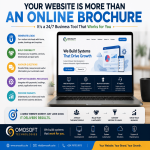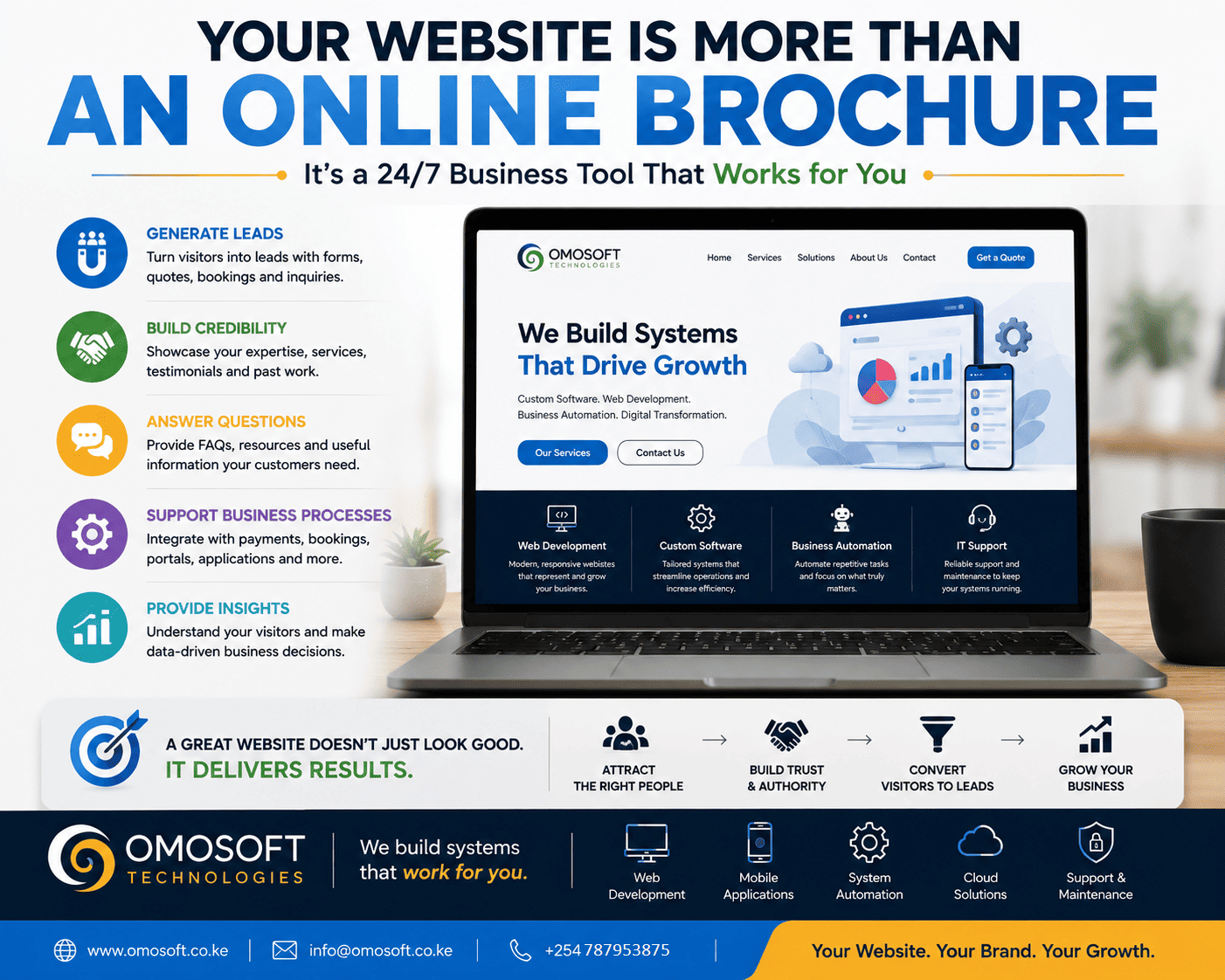
Your
Website Is More Than an Online Brochure
Many
businesses have websites.
But having
a website and having a website that actively supports your business are two
very different things.
For some
organizations, a website is treated as little more than an online brochure. It
contains a company profile, a list of services, a few images, and contact
information.
While this
information is important, a modern business website can do much more.
A
well-planned website can help your organization:
Ø Generate new leads
Ø Build credibility and trust
Ø Educate potential customers
Ø Answer common questions
Ø Support customer service
Ø Accept applications or bookings
Ø Integrate with business systems
Ø Collect useful customer insights
Ø Support marketing and sales
activities
The
important question is no longer simply:
“Do we
have a website?”
The better
question is:
“What
is our website doing for our business?”
In today's
digital environment, your website can become one of your most important
business assets.
Let's
explore how.
1. Your
Website Can Generate Leads
One of the
most important functions of a business website is lead generation.
A visitor
may discover your business through:
Ø Google search
Ø Social media
Ø A recommendation
Ø Online advertising
Ø A LinkedIn post
Ø A Facebook post
Ø An email campaign
Once they
arrive on your website, the next question is:
What
should they do?
A
strategically designed website should guide visitors toward meaningful actions.
Depending
on your business, this could include:
Ø Requesting a quotation
Ø Booking a consultation
Ø Calling your business
Ø Sending an inquiry
Ø Registering for a service
Ø Downloading a brochure
Ø Signing up for a newsletter
Ø Requesting a demonstration
These
actions are commonly referred to as calls to action, or CTAs.
Examples
include:
Request a
Quote
Book a
Free Consultation
Talk to an
Expert
Get
Started
Request a
Demo
Download
Our Guide
Without a
clear next step, visitors may read your website and leave without ever
contacting you.
A website
designed for lead generation should make it easy for potential customers to
understand what you offer and what they should do next.
2. Your
Website Helps Build Trust and Credibility
Before
contacting a business, many potential customers will search for information
online.
They may
want to know:
Ø Who are you?
Ø What services do you offer?
Ø Have you worked with organizations
like ours?
Ø Do you have relevant experience?
Ø Where can we find examples of your
work?
Ø How can we contact you?
Your
website can help answer these questions.
A
professional website gives you an opportunity to clearly communicate your:
Ø Company background
Ø Services
Ø Experience
Ø Expertise
Ø Portfolio
Ø Case studies
Ø Client testimonials
Ø Team
Ø Contact information
Trust is
especially important when a customer is considering a significant investment.
For
example, an organization looking for a company to develop a custom software
system may spend time evaluating several providers.
A clear
and professional website can help demonstrate that your business understands
its field and has the capability to deliver.
Your
website may not close the sale on its own.
But it can
play an important role in moving a potential customer from:
Awareness
→ Interest → Trust → Inquiry
3. Your
Website Can Answer Customer Questions 24 Hours a Day
Your team
cannot answer every customer inquiry immediately.
But your
website can provide useful information even when your office is closed.
Consider
the questions customers regularly ask:
Ø What services do you offer?
Ø How does the process work?
Ø How can I request a quotation?
Ø What information do I need to
provide?
Ø How long does the service take?
Ø Where are you located?
Ø How can I contact support?
If your
business receives the same questions repeatedly, some of that information may
belong on your website.
Useful
website content may include:
Ø Frequently asked questions
Ø Service pages
Ø Pricing information where
appropriate
Ø Knowledge bases
Ø User guides
Ø Downloadable documents
Ø Blog articles
Ø Tutorials
This can
improve the customer experience while reducing the time your team spends
answering repetitive questions.
The goal
is not to remove human interaction.
The goal
is to make useful information easier to access.
4. Your
Website Can Become Part of Your Sales Process
A website
should not necessarily exist separately from your sales and marketing
activities.
Instead,
it can support the customer journey.
For
example:
Step 1:
A potential customer discovers your content
They may
find one of your blog articles through Google or see an educational post on
LinkedIn or Facebook.
Step 2:
They visit your website
The
website provides more detailed information about the topic or service.
Step 3:
They learn about your business
They
explore your services, projects, expertise, and approach.
Step 4:
They take action
A clear
call to action encourages them to:
Ø Request a consultation
Ø Submit an inquiry
Ø Request a quotation
Ø Contact your team
In this
way, your website can help turn attention into potential business
opportunities.
This is
why content, social media, search visibility, and website strategy should work
together.
A strong
content strategy can attract visitors.
A
well-designed website can then help convert those visitors into leads.
5. Your
Website Can Support Online Applications and Registrations
Depending
on your organization, a website can do much more than provide information.
It can
allow users to complete important processes online.
For
example:
Ø Submit applications
Ø Register for programs
Ø Apply for membership
Ø Book appointments
Ø Register for events
Ø Submit documents
Ø Make service requests
Ø Complete forms
Ø Track application status
This can
improve convenience for both customers and staff.
Instead of
requiring someone to physically visit an office or send information through
multiple emails, the process can be managed through a structured digital
workflow.
For
organizations that process a large number of applications or requests, this can
significantly improve efficiency.
6. Your
Website Can Integrate With Business Systems
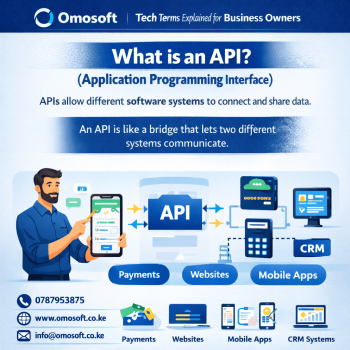
A modern
website does not have to operate as an isolated platform.
Depending
on your requirements, it can connect with other systems and services.
Examples
may include:
Ø Payment platforms
Ø Customer relationship management
systems
Ø Booking platforms
Ø Email marketing systems
Ø Customer portals
Ø Member management systems
Ø Learning management systems
Ø Inventory systems
Ø Custom business applications
For
example, a visitor could submit an inquiry through your website.
That
inquiry could then be sent automatically to a customer management system where
your team can track follow-up.
A member
could log into a secure portal.
A customer
could make a payment.
An
applicant could submit information and track the progress of their application.
The
possibilities depend on the specific needs of the organization.
The
important principle is that your website should support your wider business
processes where appropriate.
7. Your
Website Can Provide Valuable Business Insights
A website
can also help you understand how people interact with your business online.
Analytics
can provide useful information such as:
Ø How many people visit your website
Ø Which pages receive the most
attention
Ø Where visitors come from
Ø Which content attracts interest
Ø What devices visitors use
Ø Which campaigns generate traffic
Ø What actions visitors take
For
example, you may discover that:
Ø A particular service page receives
significant traffic.
Ø Visitors frequently search for a
specific solution.
Ø One blog topic generates more
inquiries than another.
Ø Most visitors leave before
completing a particular form.
These
insights can help you improve your content, marketing, user experience, and
business strategy.
The
objective is not simply to collect data.
It is to
use information to make better decisions.
8. Your
Website Can Help You Demonstrate Expertise
Many
businesses compete by simply saying:
“We
provide high-quality services.”
“We are
the best.”
“We offer
professional solutions.”
These
statements are common.
A more
effective approach is to demonstrate expertise.
One of the
best ways to do this is through useful content.
For
example, a software development company can publish articles about:
Ø Business automation
Ø Custom software
Ø Digital transformation
Ø Website strategy
Ø Artificial intelligence
Ø Cybersecurity
Ø Data management
This
approach provides value before the customer makes contact.
Over time,
useful educational content can help establish your organization as a
knowledgeable and credible provider.
Instead of
only saying:
“We
develop websites and software.”
The
company can demonstrate its expertise by explaining:
How
businesses can use technology to solve real operational problems.
That
distinction can help build trust with potential clients.
9. Your
Website Can Support Customer Self-Service
Customers
increasingly expect convenient access to information and services.
Depending
on the type of organization, a website can provide self-service capabilities
such as:
Ø Customer account access
Ø Document downloads
Ø Application tracking
Ø Appointment booking
Ø Invoice access
Ø Support requests
Ø Knowledge bases
Ø Account updates
A customer
portal can allow users to complete certain tasks without waiting for manual
assistance.
This can
improve convenience while helping organizations manage customer interactions
more efficiently.
However,
not every business needs every feature.
The right
functionality should be based on actual customer and operational needs.
10. A
Good Website Should Have a Clear Purpose
One of the
biggest mistakes businesses make is developing a website without defining what
success looks like.
Before
developing or redesigning a website, ask:
- Who is the target audience?
- What information are they
looking for?
- What problem are they trying
to solve?
- What action should they take?
- What services should receive
the most attention?
- How will the website generate
leads or support customers?
- What systems should the
website connect to?
- What will success look like?
A website
for a software company will have different objectives from a website for:
Ø A school
Ø An NGO
Ø A SACCO
Ø A hospital
Ø A law firm
Ø A church
Ø A real estate company
Ø An e-commerce business
The design
and functionality should support the organization's specific goals.
What
Makes an Effective Business Website?
A
successful business website does not depend only on attractive design.
Design
matters, but it should support usability and business objectives.
An
effective website should generally include the following elements.
1. A
Clear Value Proposition
Visitors
should quickly understand:
Ø What you do
Ø Who you serve
Ø What problems you solve
Ø Why they should consider your
business
Avoid
forcing visitors to search through multiple pages to understand your core
offering.
2.
Clear Navigation
Users
should be able to easily find:
Ø Services
Ø About information
Ø Portfolio or case studies
Ø Blog or resources
Ø Contact information
Complicated
navigation can make it difficult for visitors to find what they need.
3.
Clear Calls to Action
Every
important page should guide the visitor toward a logical next step.
For
example:
Ø Contact us
Ø Request a quote
Ø Book a consultation
Ø View our services
Ø Read a related article
4.
Mobile-Friendly Design
Many
people access websites using mobile devices.
Your
website should therefore provide a usable experience across different screen
sizes.
5. Fast
and Reliable Performance
A website
should be designed and maintained with performance in mind.
Slow-loading
pages can create a poor user experience.
Images,
scripts, hosting, and website architecture can all affect performance.
6.
Useful and Relevant Content
A visually
attractive website with unclear or unhelpful content may still fail to generate
results.
Content
should help visitors understand:
Ø The problem
Ø The available solution
Ø The benefits
Ø The next step
7.
Trust Signals
Trust can
be strengthened through relevant information such as:
Ø Client testimonials
Ø Case studies
Ø Portfolio examples
Ø Certifications where applicable
Ø Team information
Ø Clear business contact details
The goal
is to help visitors feel confident that they are dealing with a legitimate and
capable organization.
Your
Website and Search Engine Optimization
A
well-designed website can also support your long-term digital marketing
strategy.
When
potential customers search for information related to your services, useful and
relevant website content can help attract organic traffic.
For
example, Omosoft Technologies can create content around topics such as:
Ø Does your business need custom
software?
Ø Has your business outgrown Excel?
Ø How can businesses automate manual
processes?
Ø What makes an effective business
website?
Ø Custom software vs off-the-shelf
software
Each
article can answer a real question that potential clients may be asking.
This
creates an opportunity for your website to become a source of valuable
information—not simply a digital company profile.
The
process can work as a content ecosystem:
Educational
Content
↓
Search and Social Media Visibility
↓
Website Visit
↓
Trust and Education
↓
Inquiry or Consultation
Over time,
a library of useful content can become a valuable digital asset for your
business.
Don't
Build a Website Just Because Everyone Else Has One
A website
should be developed with a purpose.
Before
investing in a new website, ask:
What
business problem should this website help us solve?
The answer
may involve:
Ø Generating leads
Ø Building credibility
Ø Improving customer service
Ø Selling products online
Ø Accepting applications
Ø Managing bookings
Ø Providing customer self-service
Ø Sharing knowledge
Ø Supporting marketing campaigns
Once the
objective is clear, the website can be designed around that purpose.
How
Omosoft Technologies Approaches Business Websites
At Omosoft
Technologies, we believe a website should do more than simply look
professional.
It should
support the goals of the organization.
Before
development begins, important questions should be considered:
Ø Who will use the website?
Ø What are they trying to accomplish?
Ø What information do they need?
Ø What actions should they take?
Ø How can the website support the
wider business process?
Ø What functionality is genuinely
necessary?
Depending
on the organization's needs, a website may include:
Ø Lead generation forms
Ø Customer portals
Ø Online applications
Ø Booking functionality
Ø Payment integration
Ø Content management
Ø Dashboards
Ø System integrations
Ø Custom web applications
The goal
is not to add technology for its own sake.
The goal
is to create a useful digital solution.
Your
Website Should Work for Your Business
A website
should not simply exist because every organization is expected to have one.
It should
have a purpose.
It should
help people:
Ø Discover your business
Ø Understand your services
Ø Trust your organization
Ø Find useful information
Ø Take meaningful action
Ø Connect with your team
For some
organizations, a simple informational website may be enough.
For
others, the website can become an important part of their sales process,
customer service, operations, and digital transformation strategy.
The
important question is not:
“Do we
have a website?”
The better
question is:
“What
is our website doing for our business?”
When your
website is built around a clear strategy, it can become much more than an
online brochure.
It can
become a business tool that works for you.
Ready
to Build a Website That Works for Your Business?
If your
current website is outdated, difficult to manage, generating few inquiries, or
simply acting as an online brochure, it may be time to review its purpose and
performance.
Omosoft
Technologies helps businesses and organizations develop digital solutions that
support real business goals, including:
Ø Professional business websites
Ø Custom website development
Ø Web applications
Ø Business automation
Ø System integration
Ø Customer and member portals
Ø Digital transformation solutions
Our
approach begins by understanding what your organization needs to achieve.
Because a
website should not simply represent your business online.
It
should work for your business.
Omosoft
Technologies — Building Digital Solutions That Solve Real Business Problems.